La Coquette

A small group had been at a (really fancy, oddly enough) bar named after some US state, perhaps Kansas? I forget.
We were watching a Champions League game, and after it was over my roommate Emma and I, and two guys in Emma’s program, Michael and Matt, all went in search of something significantly cheaper.

Michael and I didn’t want to go somewhere dime-a-dozen like Cien Montaditos (that is good if you’re trying to grab a cheap bite and a quick drink, but that wasn’t our aim this evening in question).
So the four of us wandered.
And wondered.

And wandered.

For probably close to an hour, the four of us traipsed the space in between the museum triangle all the way to Plaza del Sol, which is a bit of a walk on foot.
It was early February, so not particularly warm, and we had been in the mood for a drink for some time.
Just as Emma and Matt’s patience grew thin, Michael or I (I forget whom) spotted a sign above a door that looked like it led to nowhere. As a matter of fact, I think I said something like that, like how could this possibly be a bar? There is a store just around the corner…
img_0800

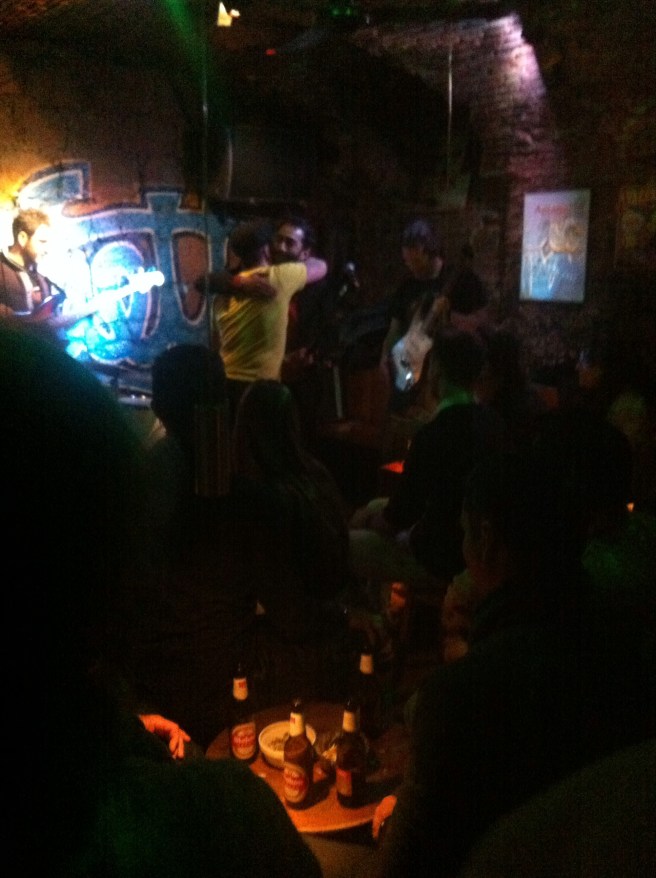
Well, it was a tiny TINY jazz bar crammed into an old brick cellar.

There are many bars and restaurants throughout the city housed in old cellars and tunnel ways.
Tunnels were popular during the Guerra Civil (Civil War) in the 20s, and the cellars speak to a period when every home and restaurant kept local wine, cheese, and root vegetables on hand.

La Coquette was quite near Plaza del Sol, just off one of the streets.

https://www.yelp.com/biz/la-coquette-madrid
img_0801

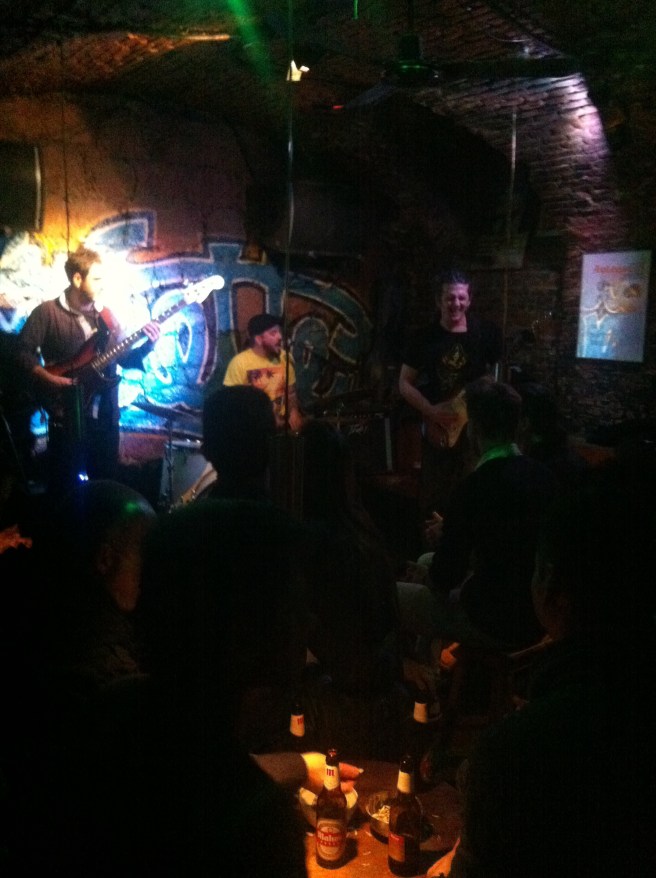
The night we went, whoever it was playing had the room PACKED, which didn’t seem like it would be hard– the place only sat around 40, but with how interactive their set was, I suspected either they played there quite regularly and all the regular patrons liked them, or they knew the owners and it had drawn a crowd.
It was pretty basic jazz, and quite good. The bar tender was grizzled, didn’t seem thrilled at having four American students in his bar, but when he realized we all spoke Spanish and weren’t there to get sloppy drunk he was happy to fill us in on what we’d found.

They have live music every night of the week, save for Thursday. They were in the cellar of what had once, long ago, been a restaurant, and he gave us the name of the band’s front man, who he clearly new when they dos besos-ed at the end of the night, though with time I’ve forgotten it.
img_0803

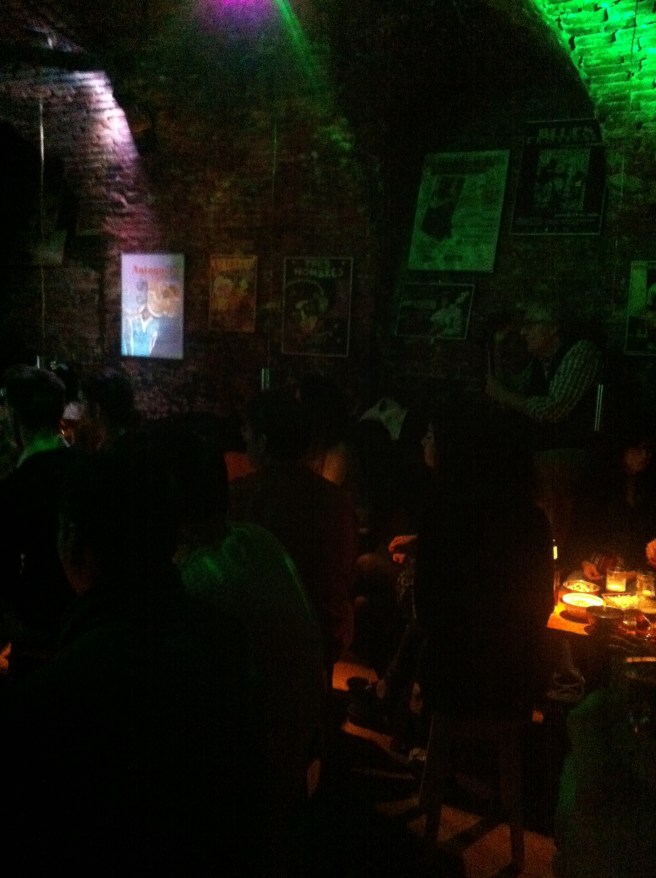
It was a dark little joint (as you can tell from my photos), and the sound of the band really fills the space. This is not a place you go to talk.

There bar offerings were pretty general, nothing that stood out, but as we walked back up the stairs to leave, we crossed paths with the front man who had been loading up their equipment, and he winked at me and asked ¿Te gusta la musica, bella? which happily caught me off guard and had me stammering out some half-assed Spanish answer. Also, probably the only time I was openly flirted with in Spain, so praise God for musicians.
 

Familia

IMG_1596
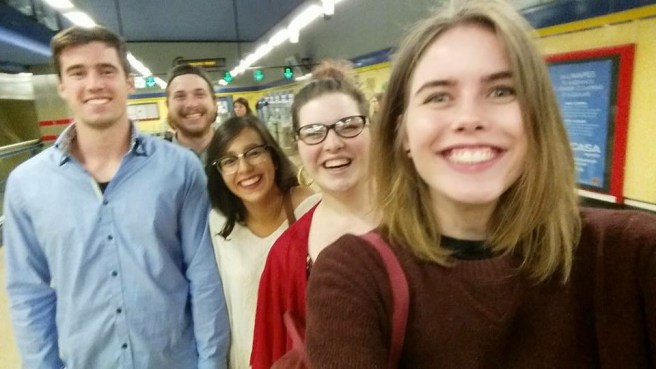
Here’s a photo from our last family dinner. Picture blurry, joy quite clear.


The first or second day of classes in Madrid we went around and introduced ourselves to the class, per usual.

I paid no mind to it really, I had no plans to make friends– again, I had museums to memorize and a city to get lost in.

That plan was quickly scraped on the second day when Oda, the cool Norwegian, and I were paired together for an exercise.
Then, sometime soon after that, a jest was made about French, and a boy in the back rivered out a response in the language.
Tri-lingual? I wanted to meet that young man.
That’s how Oda and I met Marc, a student from Rochester, and his friend from class Alex, a skateboarder from Chicago.

madrid_uan
A picture of my university from the ISA website

This little group of kids from classes dined together occasionally, and it was warmly referred to as, “family dinner.” We were the people we regularly hung out with, in and out of school. We celebrated a couple birthdays together, invited each other to bars we’d found, and I gave one very promising tour of the Reina Sofia.

These are the people I discovered Naturbier with.
These are the people I texted in a drunken flurry after I went out with an Olympic-hopeful sailor in Mallorca.
The group who I stayed in one night on a weekend excursion to Salamanca just to text them all night, laughing like a loon.
The group my second Real Madrid game was planned with, who I watched the Champions League games with.
Once, we even watched a Cavaliers game at a beloved Cuban bar– La Fontana del Oro.

img_1628
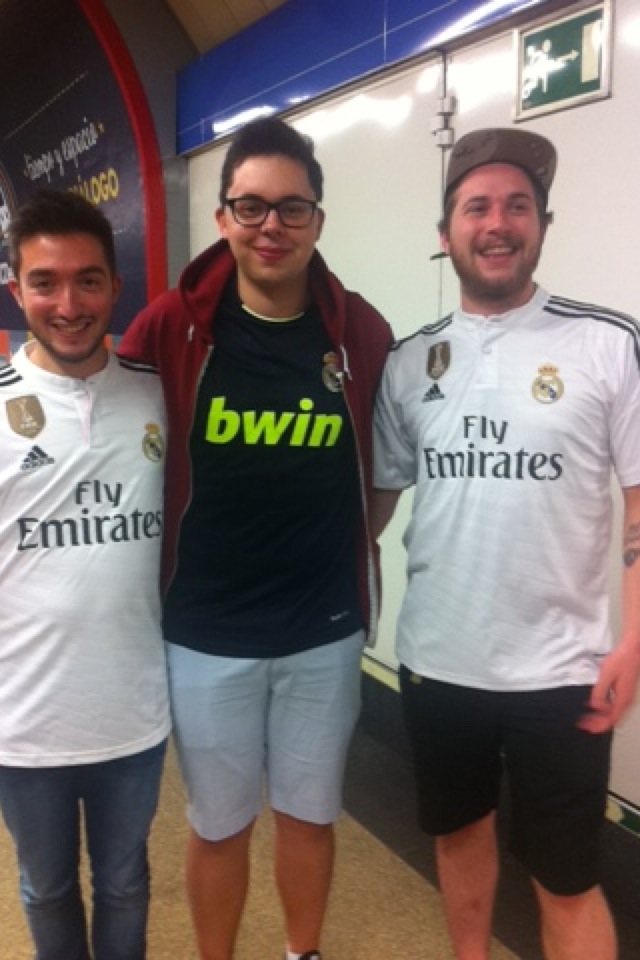
Right to left: Alex, our classmate Felix (from Germany), and his roommate before a Real Madrid game

This is the greatest gift studying abroad gave me: friends so fierce I can’t believe it really happened.
I think it was something about none of us knowing ANYONE else going into our program, and then just finding these little slivers of commonality that ended up being wide rivers of shared interests. It’s like summer camp best friends, but instead of a week together, you spent five months together. Instead of weaving keychains, you had to synergize to communicate with the ticket taker at a sporting event, or deliberate on what train line will get you somewhere faster.
The group shared restaurant recommendations and discovered a city together. We were close because it was a human necessity to build relationships quickly. We were surviving and thriving together in a foreign, magical place.

Looking back on my decision going into study abroad (that I wouldn’t make friends, so I could focus on exploring the city and improving my Spanish), I was so stupid.

Realistically, I am wildly social and extroverted. People tractor-beam to me naturally, whether any of us mean it intentionally or not. Me going five months without developing new friendships was a ridiculous idea. Whether people came to me, or I to them– I was going to meet people and we’d like each other.
ALSO when studying abroad, you have something in common with this small group of people that you share with no one else in your life. You have a few months in paradise, an experience so wonderful you will have a hard time putting it to words when you return home, and really, no one back home understands. Even other people who studied abroad didn’t study abroad with you.
This group of people did.
So for that reason alone, you should put effort forth to bond with them and love them.


img_1399
Oda (and I) smoking outside of the uni, waiting for friends to get out of class


I’m glad I found my little familia in Madrid.

Note to a makeup junkie

I have thought long and hard about what makeup I’d take to Madrid if I lived there again.

**NOTE: this post has a Sh*t Ton of links in it to the products I mention, please feel free to check out the products and tell me what you think of them**

When I was there I needed to buy foundation primer and foundation, both of which ended up being disappointing ventures.

On the plane over to Europe there was duty-free Smashbox Iconic Photo Finish foundation primer, one of the best primers on the market, and it Had No Tax y’all.
And I didn’t buy it. I needed primer, but I wanted to check out the selection at Madrid’s Sephora locations when I landed.

HUGE MISTAKE.

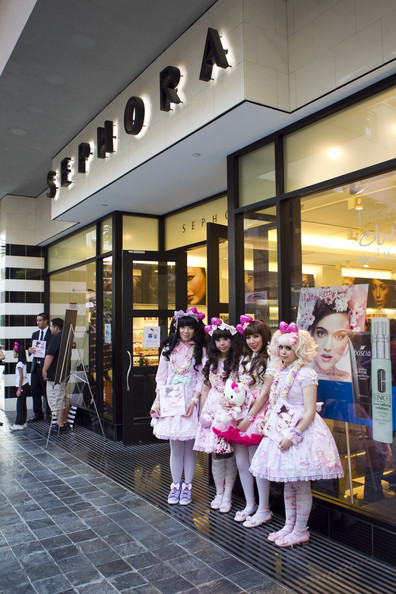
Sephora has a Much smaller selection in Madrid than it does in the stores I’m familiar with in Texas.

sephorahellokittybeautyeventhellokittylcialhloyw3l

Smashbox, for instance, doesn’t sell in Spain (or so a very helpful makeup artist told me at the Puerta del Sol Sephora). He told me to use the Marc Jacobs, which I’m sure is great, but is also freaking expensive.
I ended up getting a Too Faced primer, and it did fine BUT…

I had to get foundation, too, and quickly realized there was not the same selection of colors in Bare Minerals as there was back home. I am quite literally the colour of milk.
If you know me, there’s a good chance I am literally the whitest person you know. And n o t h i n g was light enough, which surprised me because there are some pretty darn light Euros.

(I once contemplated asking a really light girl where she got her foundation, but abstained because I didn’t want to be rebuffed if she was an especially sticker-y madrileña.)

Anyway, I ended up getting the lightest, which was Fairly Light. I normally wear Fair, which is still too dark sometimes in the winter. So here I was in Spain, wearing obviously-too-dark foundation (which I skipped most of the time it flustered me so much) with a primer I wasn’t in love with.

SO let’s get to the point. I’ve come up with a list of things I’d pack in my makeup bag, now that I know better.

Brushes

dsc00189-2-800x449

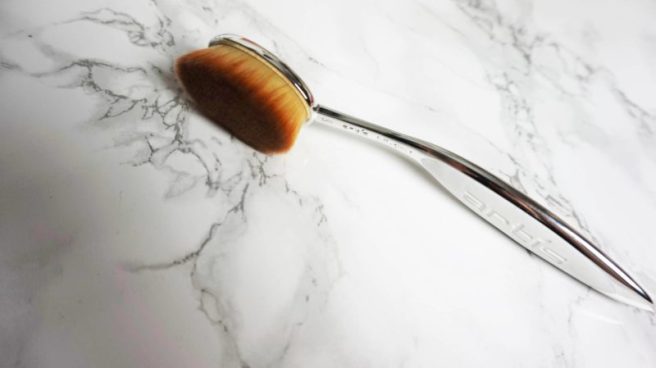
  • Artis brush Oval 7– this brush is very expensive BUT you can use it for foundation, wipe it off on a towel, powder, wipe it off on a towel, and then blush! It takes the place of three brushes. I also know girls who use it to contour with even AFTER those three steps. You just need to wipe it off well between products and keep it clean. The Artis brushes are a makeup fanatic’s dream.
  • Artis brush Oval 4– this is the best all-over eyelid brush I have ever used, and is also great for highlighting. Again you can wipe it off again and again to use different products. I generally just use it for whatever is the base shade of eyeshadow I’m using, and the first highlighter I’m using (I wear 3 most days).
  • Lancome Blending Tip brush #16– This is the greatest eyeshadow brush I have ever used for the crease of your eyes. It is easy to use it to blend in towards your lashline or out towards your brow bone. Between the Oval 4 and this, you should be set for eye brushes.
  • Morphe M510 (for highlighter) really great for people into the extreme highlighting look that is really in right now, it blends really well and you can use it along the center of your nose, the top of cheek bones, the cupid bow of your lip, and the little indent under your lips. Also, don’t be afraid to use fingers for highlight. (use MANNYMUA for 10% off the entire site, they have great brushes I hear, but I haven’t used them extensively)

Makeup

 If you’re a very light or very dark shade, and want to wear a high-end brand: as much of your foundation (&/or powder) as you’ll need for your time there (if this is longer than 6 months, arrange for someone to mail you some when you run out). Otherwise you can probably find it in Madrid when you run out. I talk about that here.
  Because of Madrid’s climate, I’d recommend something really high-moisture. Maybe Make Up For Ever’s HD foundation? It’s won an Allure Beauty award and I really trust those, and I used it for a while and like it.
Also, the ultra-smooth, relatively hydrating Dior Airflash spray foundation might not be convenient for carrying on, but it’d have a lower chance of leaking like a bottle with a lid would.
Also, the company Hourglass makes the most amazing foundation sticks that blend out really well, so I’d think its easy to pack and carry & you don’t have to worry about it melting! I wear the shade Blanc. Perfect for travel.

  Color Pop or Dirty Little Secret highlighters: they are small, so they don’t take up space in your bag, but have a lot of pigmentation, so they are the best bet long-term.

  I would recommend taking an eye shadow palette with matte neutrals in it. The girls of Madrid don’t wear much makeup, the natural look is very in. I’d not wear much sparkle. MAC has build-your-own palettes on their website, so I’d build one with nude-tone mattes myself. Maybe throw in one soft shimmer to add some dimension on a big night out.

mascara Mascara MASCARA I wear three layers of three different kinds on any given day. I am Obsessed. I can’t even tell you which one(s?) I’d take. Lancome and Smashbox make some of the best ones out there!!!

 I’d probably take a few more things, just for variety, but there is nothing else I’d feel woeful without. I do love Dior’s Sculpt Professional Contouring Powder Blush and I have a few black liquid eyeliners I like, Aurora Intensely Precise eyeliner being The One currently (and I sure as hell would take a black liquid eyeliner with me, NO DOUBT). NARS comes close!!! My #1 overall right now is actually a twist pencil from Vasanti Kajal eyeliner– it is so wow.

Additionally

I “bake” my foundation (let powder sit on top of my foundation and soak in for 10 minutes+ while I do the rest of my makeup) so I’d recommend Chanel’s POUDRE UNIVERSELLE LIBRE (their packaging is often all caps, for whatever reason).
It is expensive, but you get a lot of product, and have to use almost none at all, so it lasts FORever. I use a beauty blender to bake (another Allure award winner).

6ae87b64c17a929b0fbd1ce81aad58c9

Madrid: what to pack

This is an exhaustive packing list
Trust me

This is with the idea in mind of spending a semester/school year in Madrid, less time obviously will require less things
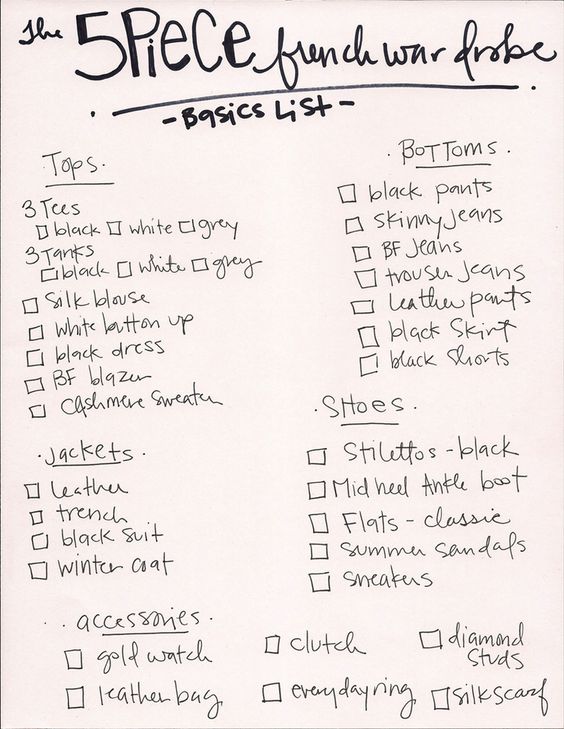
1. You need a packing list of what you’re bringing, so you don’t forget anything, but also so you don’t go wild.
2. Everything is easier if you’re working inside of a color family, then everything you bring can mix&match.
I pack all in black, white, grey with occasional orangey-tan or baby pink. I also have a red wool scarf I wear all winter that is a nice pop. I talk about dressing to belong here.
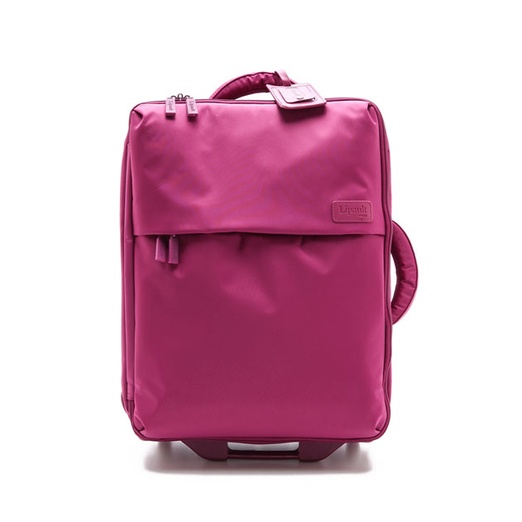
3. If you’re buying a suitcase, don’t buy black. EVERYONE ELSE will have black. You need to easily recognize your bag. Mine is baby pink, yours can be red. Don’t get plain black.
Pivoting bags are especially easy. Don’t forget to tag your luggage.

COLOR

lipault-paris-foldable-22-wheeled-carry-on-bag

•a towel
•gloves
•an umbrella
•as many pairs of underwear as you own (or 15 pairs, whichever you hit first)
your preferred deodorant (the liquid ones sold predominantly across Europe I hate, you’ll want a stick one)
•if you’re picky about hair products, those, too (my hair is very, very dry and both coconut oil and Moroccan Oil products are much more expensive in Spain)
•a few pairs of shoes that are comfortable to walk in for extended periods of time (I’d say four pairs if you’ll be there for 6 months)
-suggestions: a pair of boots, a rainboot (really), sandals with a back strap, some sort of informal shoe (a sleek athletic shoe, sneaker, or loafer)

16dcb4036fa0ba3fee7ccd01887f21cc

REMEMBER: color family makes the below not feel limited, because mix & match

one light jacket (leather, denim, or a trench coat)
one coat
a winter scarf
a light scarf (for cool spring nights)
2 dresses (one nice/one simple)
2 button ups you can dress up/down
2 heavy sweaters (it does get cold in the winter in Madrid)
4 long sleeve tops
4 short sleeve tops
2 tank tops (again one nicer than the other)
2 pairs leggings
Pants: if your thighs touch, 5 or 6 pairs. If your thighs don’t touch, less. The only reason I make this stipulation is because as you walk EVERYWHERE in Europe, your thighs may rub and rip your pants, so you’ll need back-ups. Maybe you’re ok with buying new pants in Europe, I just had a hard time finding ones that fit right.
2 skirts (if you wear them normally at home, if not skip it)
As few accessories as you can manage- Madrid women don’t accessorize heavily, I tried to follow suite

  • toothbrush (you can buy toothpaste there)
  • if you’re not picky about toiletries buy them there, if you’re like me and wildly picky about what you put on your body, pack ’em
  • regularly used electronics and their chargers (don’t pack stuff you don’t use at home, you sure won’t use it in this entertaining city)
  • vitamins, if you take them, as they can be pricey in Madrid
  • makeup carefully packed DON’T check it, something will be confiscated
  • a swimsuit (just in case)
  • regularly used personal items and medications (tweezers, tampons, nail clippers)
  • VOLTAGE ADAPTER
  • sunscreen, if you’re so inclined, its hardish to find most of the time
  • a cross body purse
  • I brought a photo of my little brother in my favourite picture frame, to feel at home


Pack liquids in bags. I am a makeup junkie, so everything gets stuck in makeup bags, just of varying sizes. Normal people, please feel free to use Glad bags.

**DO NOT** bring

flip flops
high heels

On fitting everything into an easily carried bag:

roll, don’t fold
&
fit little things inside your shoes

Carry on considerations:

a scarf (as recommended above), to stay cozy on the plane
You could use a water bottle
Passport & medications in their bottles
the light jacket you’re bringing- airplanes and airports can get cold
your laptop, if you’re bringing it
a journal or a book, if you’re inclined
wallet

***A cute post on what a well packed bag looks Cup of Couple.
Also, this Instagram account is a great follow, they live in Madrid part of the time and make great restaurant recommendations.

Surprise! Calle de la montera

“You know, the street with all the prostitutes.”
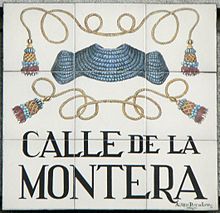
You’ll hear this pretty frequently from study abroad students giving directions to somewhere. It’s Calle de la montera they’re referring to.
It is one of the only (maybe the only) street whose name I actually knew, because I hated calling it “prostitute street” like so many of my classmates, it’s degrading to the women working there. But to be honest, it is a wildly accurate description.
A lot of newbies to the city are startled by how packed with working girls this street is in the evenings, but in reality, this is one of the safest streets in the city to be alone on, because it is so heavily patrolled by police, which is kind of the point of this post.

220px-calle_de_la_montera_madrid

As shocking as open and obvious sex work can be to an American abroad, its part and parcel on this particular street in Madrid. The locals don’t even seem to notice, and in time it does become just a part of the city’s scene. No need to be surprised, any feeling beyond that, you’re welcome to keep it to yourself as far as the madrileños are concerned.

If you are ever walking alone in the evenings– whether late, late in the AMs going home from a club or earlier– perhaps returning to Puerta del Sol from dinner– I would recommend taking this street lined with sex workers.
There are bright lights, a patrol car rolling through probably once every 15 minutes, and generally other people using the street for the same reason as you- its safety. In all my time there I think I saw maybe two transactions happen, and obviously nothing actually happens on the street.

So, like I said, this post is to point out the street’s safety, especially if you’re walking alone and not looking to get robbed on one of the more winding roads leading from Gran Via (one of, if not the busiest street) to Puerta del Sol (the most popular square in the city). Some of the girls from more conservative/traditional backgrounds had a hard time with this calle, but its just part of Madrid. Perhaps its unsavory, but it may keep you from being robbed at 4AM, so suck it up and just keep walking. They’re just ladies who have no intention of bothering you if you don’t bother them.

This post is directly in contrast to this TripAdvisor thread: https://www.tripadvisor.com

P.S. Actually, now that I’m thinking about it, I remembered something.

I am a ridiculous Texan who says excuse me to people who bump into me on busy city streets. My best friend told me Madrid would break me of that but it didn’t. I also smile pretty much all the time, especially if I look at someone.
Once, walking to an early drink and tapas in Malasaña (just past Gran Via) and I met eyes with one of the women. I was smiling without thinking, and she smiled back.
This surprised me, because madrileños don’t smile at people they don’t know (and even then its rare).
I realized she’d probably done so because a lot of the girls are South American immigrants. I wouldn’t be surprised if some of them had to take up their work because of lost jobs due to Spain’s economy bottoming out, and so much of the population losing their jobs.
She was one of the only people to smile at me my whole time there.

A Wanderer’s Paradise

La Latina on a Sunday morning: it’s something you need to do.
I tried to go every Sunday morning, but only actually made it four times in 6 months (hi, Saturday night clubbing).

9 AM breakfast: pop into the restaurant next to Hotel Puerta de Toledo. The little eatery (whose name isn’t memorable) is a dime-a-dozen place, but its in La Latina at your exit (Puerta de Toledo on Line 5).
The hotel and this little place share a section of the round-about street that surrounds the actual Puerta de Toledo. Look for the Hotel, you’ll find this place. Sit down, enjoy and AM gin & soda and a croissant. Watch passers-by.

puerta-de-toledo-a-madrid

10 AM Puerta de Toledo:  the metro stop that you’ll need to get off to go to El Rastro, the HUGE open air market (think flea market, not farmer’s market). This is where you’ll head after breakfast.

El Rastro is SPRAWLING and covers block after block of the La Latina neighbourhood. Booths usually go up at about 10 AM and come down sometime between 1-3PM, and they’re only open Sundays.
At one of the Puerta de Toledo metro exits there is a library and a row of cherry blossom trees, follow the trees back into their little alcove and you’ll come across a booth with an expansive collection of antiques, very cool to look through. From that point, you can just follow the booths back.

11 AM: By this point you’ve wandered pretty deep into La Latina, past all the touristy booths at the mouth of El Rastro, into the parts of the market that have actually unique stuff.
The crammed book shops and jammed places packed with treasures from Morocco and beyond were my favourites.
There was a shop full of south east Asian items: jade bracelets, obviously old statues of Buddah (not something you med major bestie bought at a TJ Maxx), intricately woven tapestries so expensive your breakfast threatens to bubble back up.
There was a place with old little machines (think projectors, cameras, the like) that had a Russian alphabet, ahem Cyrillic, typewriter from the 50s.

One tiny tienda that looked like a Sultan’s treasure trove was particularly amazing. Arabesque trinkets can be found at a lot of El Rastro booths and shops, but few are authentic nor good quality. This shop has amazing rugs, beautifully crafted frames with huge mirrors in them, and little wonderful tchotchkes that you’ll wish you had another 15 lbs of luggage space to cart them home.
That’s what I loved most about El Rastro. Not only getting lost (quite literally) between all the booths and people, but stumbling into little treasure troves.

—–

My dad spent a little over 24 hrs in Madrid with me on a layover for a work trip, and he loved the market, too. He ended up getting a vintage pocket knife for my uncle at a stand that was overflowing with pocket knives. At a lot of the over-stocked booths its easy to get overwhelmed with how much crud there is and you don’t find the cool stuff hidden in the mess. This is why I just found shops devoted to a particular thing and looked through those, but my dad was happy he dug through that little stand. It’s got something for every type of shopper.

In recent years El Rastro has gotten popular again as the La Latina neighbourhood up ticks again. There for a hot minute the area was one of the rougher parts of the city, but with the dip in the Spanish economy this area has seen the resurgence of Spanishness in a manner. El Rastro is something very specifically Madrid, and madrileños are fond of things just their own, so now you get to benefit from that.
However, because of the tourist popularity of El Rastro in a not-as-nice neighbourhood, pick pockets are common, so maybe don’t carry a purse or a backpack, and instead keep cash and phones in front pocket or inside jacket pockets. If you do carry a purse, keep in pulled in front of you (purse recommendations here).

Here is a (pretty cheesy) video that mentions the market


<p><a href=”https://vimeo.com/54434674″>EL RASTRO (Diario de un viaje)</a> from <a href=”https://vimeo.com/drakkarhd”>DRAKKAR  HD(www.drakkarhd.com)</a> on <a href=”https://vimeo.com”>Vimeo</a&gt;.</p>

Yelp!

Yes, I need somebody YELP!

I recently did several Yelp! reviews on places I liked to eat in the Spanish capital.

If you’re not familiar, Yelp! is a popular restaurant review website that has become wildly popular in the last handful of years.

When I’m home in Houston my best friend eats at all these cool hole in the wall places and ethnic food joints where only people of that ethnicity eat there (Jamaican bars from heaven, a Korean place that was perfect for birthday lunch, funky kareoke bars, and the yummiest alcoholic slushies ever). So, because of her I trust Yelp!

I logged on to their site the other day because I was looking for the name of a restaurant in Madrid, and then got on a kick reviewing places I’d eaten in the city. Then, I realized I could probably find the names of all the places we ate at that I never knew, or have forgotten.

o

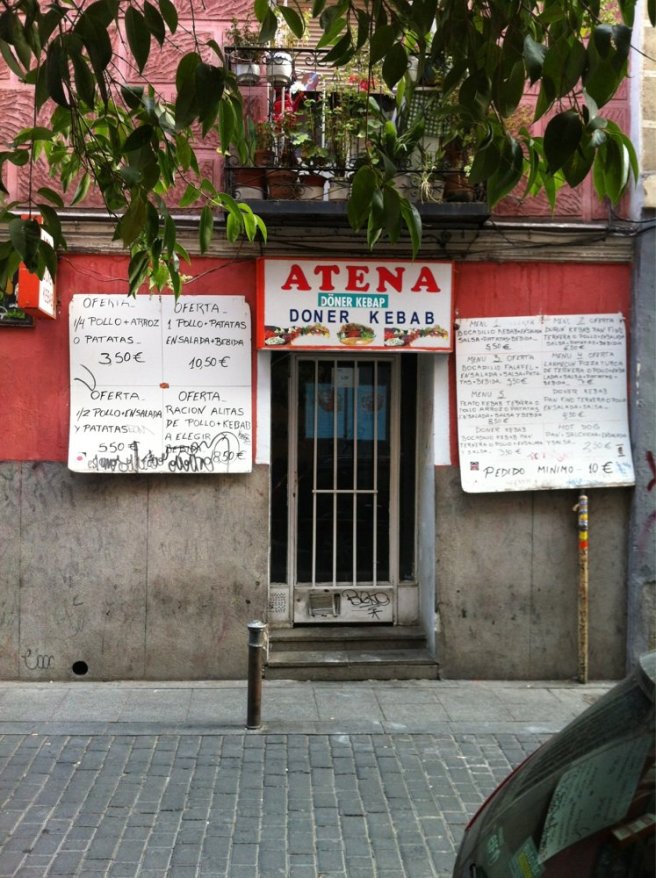
Actually, there was a kebab place I LOVED in Madrid, whose name I never actually knew when I was living there, and no one else knew it either. I found its name on Yelp! and I cannot even begin to tell you how happy it made me.
I knew what neighbourhood it is in, and had a general idea of what street it was near, and because of how Yelp! is set up, I found it pretty fast.
BEYOND PLEASED
It’s called Atena (the Spanish name for Athens, the Greek city) and (as you would know if you read my review or the original post where  I recommended the place) its incredible and felt like a piece of home.

If you’re interested in where I ate in Madrid, and what I thought of it, here is a link to my Yelp! page https://www.yelp.com

Cash is Standard

There is an ATM near a Tribunal metro entrance, near the piece of real estate that used to be my favourite bar in the city.
The ATM belongs to La Caixa, I’m pretty sure, a Catalan bank.
One night, in need of cash for bar hoping, I used the ATM, and pleasantly found there were language options. I thought I chose English, but the screen was off a little and I actually chose Euskera.
Basque, I had chosen BASQUE.
Basque is believed to be the oldest language in Europe, with no known linguistic relatives. The language is believed to have ties back to the Neolithic era, and perhaps even before that. An ancient, wild language, with crazy letter combinations and no similarity to my beloved Spanish.

And I had to make a bank transaction in it.
Thankfully, as anyone who lives in modernity knows, bank ATMs are pretty standard, and the steps you go through to withdraw money are pretty similar regardless of bank. I got my money despite the disorienting use of unfamiliar accent marks common in Basque.

This ridiculous, pointless story is but to highlight the need of cash in Madrid and what a foreigner might need do to obtain it.
Again, the ATMs are essentially the same as in the US. There were a few blessed machines I came across that gave out various denominations of bills and it was GREAT. I mean, you could get 5€ or 20€, unlike infuriating ATMs in the states where you can only withdraw in amounts of $20s. This was pretty rad when my bank account ran low.
Almost no bodegas accept debit/credit cards, and the ones that do begrudgingly accept them (often with a minimum so high you forgo whatever you thought you were about to buy).
Coins are as common, if not more so, than bills. I sort of (really, really) loved this. I felt like some kind of medieval knight being paid in gold (shhhhh they were just Euros shhhh I don’t care its cool). Obviously you can’t get these from an ATM, but most everywhere you pay with cash will give you back change in coins– so everywhere.

Get yourself a sturdy wallet with a coin pocket or a coin purse before you head to Europe, and it’ll smooth the transition, promise.

Spanish Family

If you are studying abroad and have the opportunity to stay with a host family, please do.

Really, everyone I know who has stayed with a family has looooooved it.
I know kids who have lived in their own apartments, kids who stayed in dorms– mixed responses.
Everyone I know who had a host family– loved it.

Stay with a host family, do it.

IMG_0970.JPG
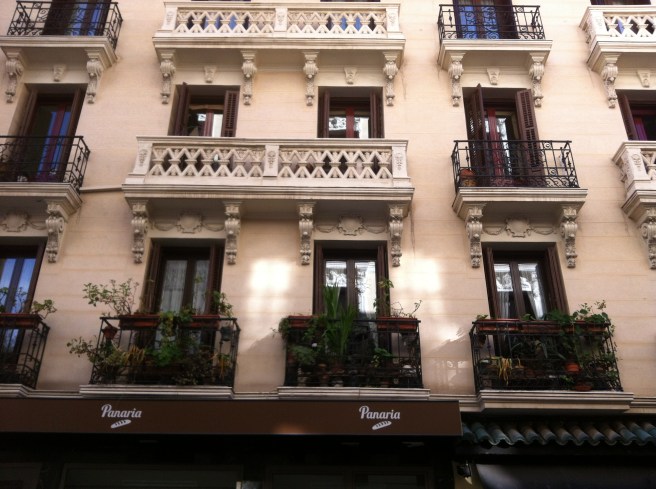
(this is not my building, but someone else lives here, right?)

If you are studying abroad with International Study Abroad (ISA)  there is a personality form that you have to fill out before you set off on your adventure that asks what you’re like, and what you expect from your family. I would recommend that you take this form very seriously. I was particular in what I expected, very honest about what I am like, and up front about what I expected to do while in Spain.

I think being super honest on that form seriously helped me get placed with the host mom that I had, who was amazing beyond words. She had worked at an art magazine, traveled extensively in South America, loved to read, watch art films,and go to art openings. I want to grow up and be her.

I know there was some hesitation from other kids in my program about staying with families that speak a language they didn’t feel 100% comfortable with.
I can’t speak for all study abroad programs, but with ISA these families had hosted multiple students before me and had been carefully screened.
They were familiar with how out-of-place a student could feel, especially with the language barrier, and they worked to make the adjustment smooth.
My roommate the first three months I was in Madrid spoke significantly less Spanish than I did, so I translated for her & our mom sometimes, but over the course of her 3-month program her Spanish capabilities ~Exploded~ because she spent so much time immersed in it at home and at school. (I don’t want that to sound like I didn’t benefit from the immersion, as well, because I really, really did).

IMG_1124.JPG
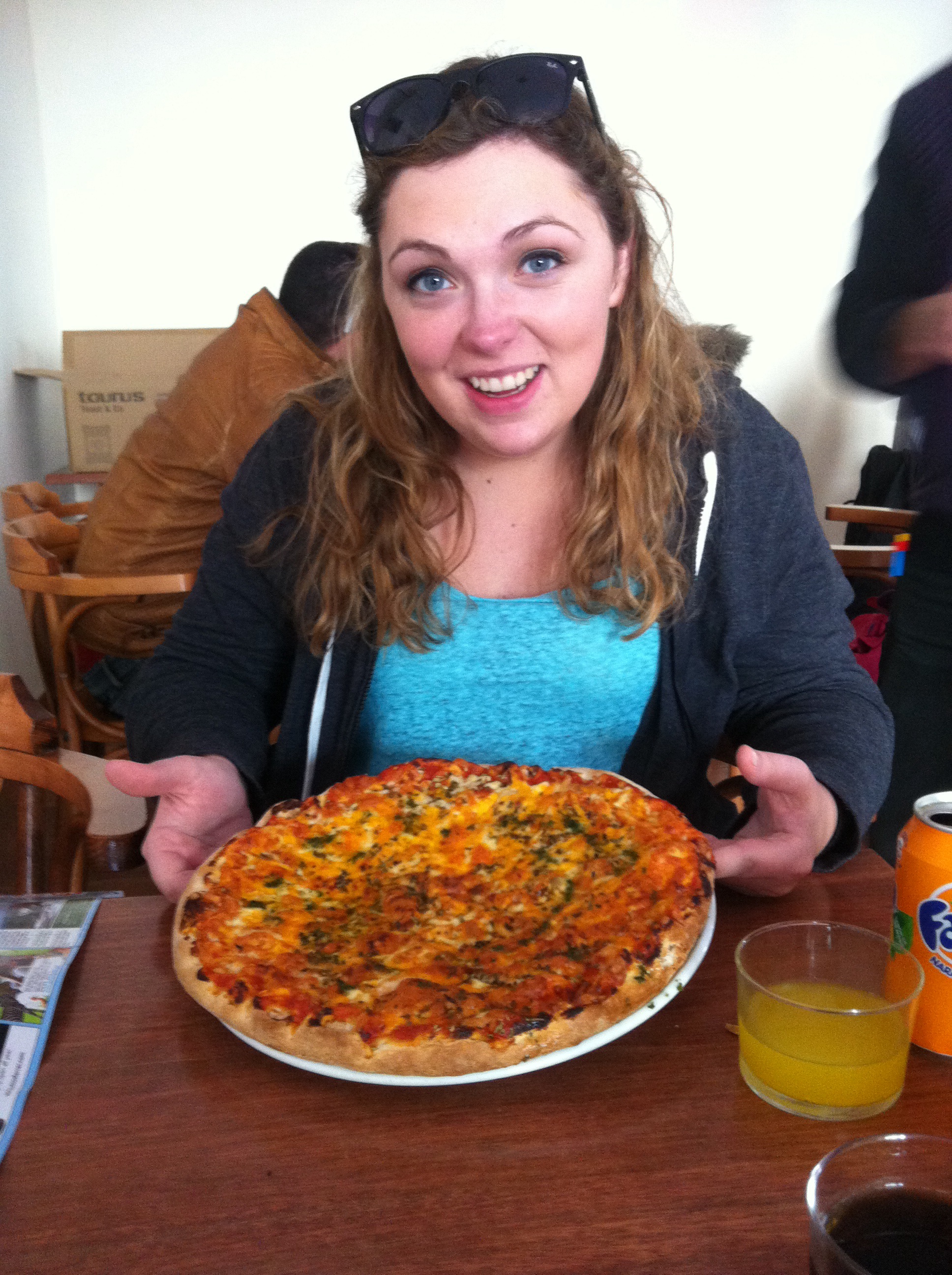
This is Emma in Mallorca, with the biggest personal pizza ever

That’s the basis of me recommending a host family above all else, because you are being exposed to the language from every front: school, out & about, and at home.
This kind of exposure causes you to learn words you’d never have a need of in formal academic settings, thus making your language knowledge more authentic and native.
For instance: hangers are perchas, the TV remote a mando. Tape was cinta.
We ate Spanish food, which meant eating way more eggs than typical to me, and it was amazing. I had no idea I liked eggs in so many forms.

img_0816
This is chicken hammered thin, dipped in mustard, and breaded. V yum.

Our host mom was a mooovie buff. She owned literal hundreds of movies, and she organized them by country of origin. This meant Emma (roommate/ sister-in-Spain) and I watched Spanish movies, and got YET ANOTHER layer of exposure both to the language and to the culture.

I watched the news most evenings with my host mom, and from that was exposed to all kinds of newsy words, and I also got a window into a Spanish presidential election cycle. My mom was super in to politicics, as am I (hello, take that personality form seriously), so it was nice having someone informed to walk me through the fast-paced, constantly shifting world of politics in Spain.

It is so easy to interact with a host family with just a bit of effort, and the linguistic rewards are HUGE, so it is amazingly worth it. Stay with a family abroad.

IMG_1627.JPG
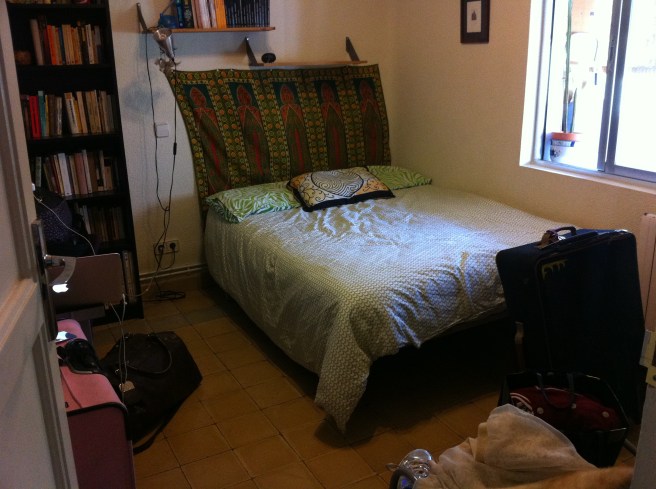
This is my room (also, please note that I severely over packed with 2 suitcases

(Also, unrealted, take more photos than you think is necessary. I didn’t take enough and constantly regret it. I was so wrapped up how great everything was while it was happening, I didn’t properly document it to share when I got home.)

**if your program doesn’t offer host families, seriously consider staying with roommates who aren’t from your home country. I had friends who were in Madrid with different programs who did this and really, really loved it. You also get the added benefit of having people to visit in other countries later on.

The University on the Hill

Once, in my Art of the Prado class, we were looking at a painting of a little prince ahorse, a mountain behind him.
Our prof points to the mountain, “Do you see that mountain?” she asked, typically brisk. She pointed out the bay of windows at the back of our class salon, to the mountain across the park, “It’s the same mountain.”
I’m not sure I’ve ever been so moved at the relevance of a lesson to my present life. I was sitting in a classroom, staring at a slide of a painting so famous it is beyond value, and its setting is across a shallow valley from me.

I gawked, she caught my eye and smirked. Smug with history like so many Spaniards.

2d057535-fe34-42a6-9f64-8c18846cb7a3Prince Baltasar Carlos on Horseback, Velasquez 1635
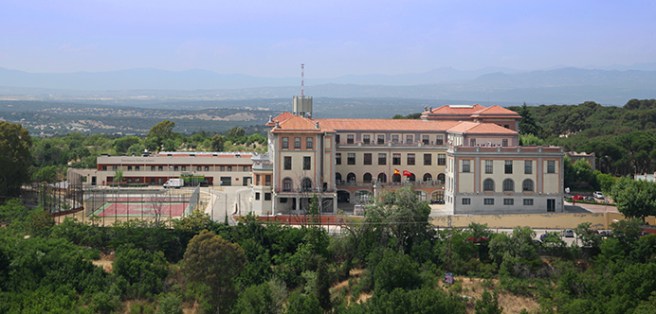
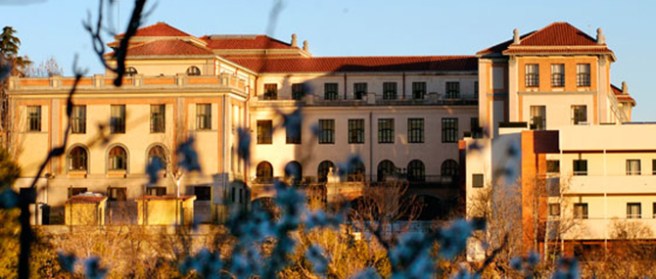
Our university was situated on what had once been an aristocratic estate, the university had served the elite of the city for its whole life, and once the mountain at the edge of the park had had a little prince ride his stately horse across it, his royal parents seeing it fit to paint.
Velasquez had painted this in 1635, I looked out the windows in 2015.

La Universidad de Antonio de Nebrija, officially.

Nebrija Universidad (for ease’s sake) sat atop a hill (a rather steep one, I might add) on a tract of land beside a HUGE park- that now is an extensive park with running trails all through it. A popular place for “footing,” the Spanish colloquialism for running/jogging as a hobby.

universidad-antonio-nebrija3_carrusel

There is a tiny, narrow staircase twisting up, up, up five times before I got to the floor with upper level Spanish grammar classes. The fifth floor, originally an attic.

Thin marble steps led up to the study abroad floor, up a staircase only wide enough for one person, but had to support two-way traffic.
At the top of the stairs there was window well you could climb into, that I napped in once, and read in a few times.
The Spanish kids that attended there were the super wealthy of the city (you only pay for Uni if you’re uber $$$- its offered free by the country, why would you pay?).
Once, my favourite prof, a man from Rioja named Andres, asked for a working definition of the slang word “pijo” (which means rich & entitled). I piped up from the back of class with, “the Spanish kids who go here.” After he was done being taken aback, he laughed. One kid had a new Mercedes G-class, he was my example when Andres asked why I’d said that. He corrected me with, “His parents bought him that.”
It was so fun, going from a little DII in the wind-swept ranchland in the Top of Texas to one of the most elite universities in a nation’s capital, with a bunch of kids who spent on clothes what I make in a year. It was the university experience I’d always dreamed of.

Tile in the halls older than my grandparents, the beautiful balconies that stretched out from the windows, chalkboards that looked straight from the set of El Espaldino del Diablo.

Apparently, the school year after I attended classes at this campus, the university moved all its courses to one of their satellite campuses, for keeping up with the historic building at the top of such a steep hill seemed no longer worth it to the university.
I am so glad I got to go to class in such a lovely building on such a gorgeous patch of land.

(The painting of the Prince, at the Prado museum: https://www.museodelprado.es)