Once, in my Art of the Prado class, we were looking at a painting of a little prince ahorse, a mountain behind him.
Our prof points to the mountain, “Do you see that mountain?” she asked, typically brisk. She pointed out the bay of windows at the back of our class salon, to the mountain across the park, “It’s the same mountain.”
I’m not sure I’ve ever been so moved at the relevance of a lesson to my present life. I was sitting in a classroom, staring at a slide of a painting so famous it is beyond value, and its setting is across a shallow valley from me.
I gawked, she caught my eye and smirked. Smug with history like so many Spaniards.
 Prince Baltasar Carlos on Horseback, Velasquez 1635
Our university was situated on what had once been an aristocratic estate, the university had served the elite of the city for its whole life, and once the mountain at the edge of the park had had a little prince ride his stately horse across it, his royal parents seeing it fit to paint.
Velasquez had painted this in 1635, I looked out the windows in 2015.
La Universidad de Antonio de Nebrija, officially.
Nebrija Universidad (for ease’s sake) sat atop a hill (a rather steep one, I might add) on a tract of land beside a HUGE park- that now is an extensive park with running trails all through it. A popular place for “footing,” the Spanish colloquialism for running/jogging as a hobby.
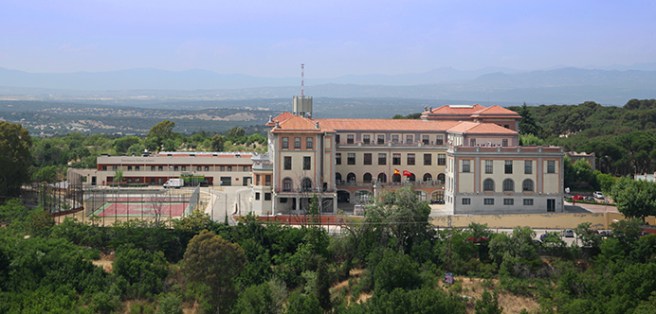
There is a tiny, narrow staircase twisting up, up, up five times before I got to the floor with upper level Spanish grammar classes. The fifth floor, originally an attic.
Thin marble steps led up to the study abroad floor, up a staircase only wide enough for one person, but had to support two-way traffic.
At the top of the stairs there was window well you could climb into, that I napped in once, and read in a few times.
The Spanish kids that attended there were the super wealthy of the city (you only pay for Uni if you’re uber $$$- its offered free by the country, why would you pay?).
Once, my favourite prof, a man from Rioja named Andres, asked for a working definition of the slang word “pijo” (which means rich & entitled). I piped up from the back of class with, “the Spanish kids who go here.” After he was done being taken aback, he laughed. One kid had a new Mercedes G-class, he was my example when Andres asked why I’d said that. He corrected me with, “His parents bought him that.”
It was so fun, going from a little DII in the wind-swept ranchland in the Top of Texas to one of the most elite universities in a nation’s capital, with a bunch of kids who spent on clothes what I make in a year. It was the university experience I’d always dreamed of.
Tile in the halls older than my grandparents, the beautiful balconies that stretched out from the windows, chalkboards that looked straight from the set of El Espaldino del Diablo.
Apparently, the school year after I attended classes at this campus, the university moved all its courses to one of their satellite campuses, for keeping up with the historic building at the top of such a steep hill seemed no longer worth it to the university.
I am so glad I got to go to class in such a lovely building on such a gorgeous patch of land.
(The painting of the Prince, at the Prado museum: https://www.museodelprado.es)

 Get Lost